Given: 7 in. P-110 casing (D/t = 7/0.59) with axial tension of 50M & internal pressure of 11M psi. Collapse pressure (psi)?
Combined tension and pressure? Complex. Use 6 DTC 4:
1) (σz + pi)/σyield = (50M + 11M)/110M = 0.554
2) Chart: --> 0.544 ---> -0.60 = (pi - pcrr)/pcr (note negative sign for collapse)
3) pcrr = pi - (-0.60)pcr) = pi + 0.6(pcr) = 11M + 0.6(pcr)
We're here in less than 2 minutes but still need pcr. The Redbook shows 7 in. P-110 casing's collapse rating is 16,990 psi. Of course you can calculate it (from D & t; see the formula on 6 DTC 2) but it's faster to use the Redbook. This allows us to calculate collapse pressure in this situation:
pcrr = pi - (-0.60)pcr) = pi + 0.6(16,990) = 11M + 10.1M = 21.1M.
3 minutes. Not bad! We've lost at least half our engineers by now on an exam. Last but not least: do a quick mental check; does internal pressure strengthen or weaken collapse? Clearly strengthen, and that's what the equation shows. Just be careful; it's easy to make a sign mistake.
Saturday, June 16, 2018

Thursday, June 14, 2018
Petroleum PE Problems 2018: 1-40
The 2018 Guidebook Companion is available on Amazon. I only publish these on Kindle to keep the cost <$10.
The sample problems look great on a smartphone or computer using the free Kindle app. The format displays two problems per page; all you need is scratch paper.
These problems reference the 2018 Guidebook exclusively (which has new sections and additional material). It also leans heavy on the SPE Handbook (although every problem can be solved using the 2018 Guidebook alone).
These practice problems were reviewed by three different 2017 PE exam takers, each giving it the thumbs-up. Harder than the 2016 and 2017 versions in my opinion (with some new twists) so I think they offer a challenge to nearly everyone. However, I personally find the 2016 version the most applicable to reality, and many agree with me. YMMV. I've been surprised at the diversity of opinion out there: one person's yawn is another person's bane.
My intent is to have problems 41-80 out by September; wish me luck.
The sample problems look great on a smartphone or computer using the free Kindle app. The format displays two problems per page; all you need is scratch paper.
These problems reference the 2018 Guidebook exclusively (which has new sections and additional material). It also leans heavy on the SPE Handbook (although every problem can be solved using the 2018 Guidebook alone).
These practice problems were reviewed by three different 2017 PE exam takers, each giving it the thumbs-up. Harder than the 2016 and 2017 versions in my opinion (with some new twists) so I think they offer a challenge to nearly everyone. However, I personally find the 2016 version the most applicable to reality, and many agree with me. YMMV. I've been surprised at the diversity of opinion out there: one person's yawn is another person's bane.
My intent is to have problems 41-80 out by September; wish me luck.
Monday, June 11, 2018
ESP
Some interesting points regarding ESPs: the older SPE Handbook (Bradley 1987) has two seemingly contradictory quotes on the same page (7-1):
a) The ESP has the broadest producing range of any artificial lift method.
b) The major disadvantage of the ESP is that it has a narrow producing rate range compared with other artificial lift forms.
What is correct? Here's what the newer SPE Handbook says regarding ESPs:
1. 200 to 20M B/D typical (30M max).
2. High-Volume Lift Capacity excellent
3. Low-Volume Lift Capacity generally poor: low efficiency & high operation costs <400 BFPD.
4. Limited by needed horsepower.
5. Can be restricted by casing size.
Hard to know what Bradley was trying to say. Just be aware of both SPE sources, and let this be a lesson on how language can make an otherwise simple question more difficult. I like to underline these "money quotes" in pencil in my Handbook when I run across them.
Friday, June 8, 2018
SPE Petroleum Engineering Certification and PE License Exam Reference Guide (Ghalambor, 2014)
Below is my Amazon review. I'm posting this here since I get so many questions about this book. As you can see, I like the book, but not for the PE Exam. Why? It's designed for a different exam, lacks number examples for the equations, and is not easy to search to find the correct formula. Feel free to ask questions or make your own assessment in the comment section below.
To be clear about what this book is: it’s a list of equations, graphs, and tables. They are broken up into the following six subjects:
Reservoir Engineering
Drilling Engineering
Formation Evaluation
Production Engineering
Facilities
Petroleum Economics
Strong points:
1. Comprehensive. I would add a few here and there, but one must draw the line somewhere.
2. Clear print. Big graphs.
3. Each variable listed after the equation.
Weak points:
A. No numbers shown with equations! This makes many hard to use, even if you understand them.
B. No explanations! You better understand these equations before you use them.
C. Let’s be clear: this book is just a list of equations/graphs/tables, nothing more.
D. No easy way to find what you need besides the six chapters. You have to know this book well to make it useful on an exam.
E. Ring bound. This is both a plus and minus, just be aware of it.
In summary: if you want a comprehensive book of equations without numbers or examples, this book is for you. I’ve found it makes for a useful office reference. Just don’t expect much more except some graphs and tables (which are not comprehensive, but pretty complete for general use). It is the primary and only allowed reference for the Certification Exam, but I wouldn't bring it to the Professional Engineering Exam unless I knew it very well and supplemented it with notes.
To be clear about what this book is: it’s a list of equations, graphs, and tables. They are broken up into the following six subjects:
Reservoir Engineering
Drilling Engineering
Formation Evaluation
Production Engineering
Facilities
Petroleum Economics
Strong points:
1. Comprehensive. I would add a few here and there, but one must draw the line somewhere.
2. Clear print. Big graphs.
3. Each variable listed after the equation.
Weak points:
A. No numbers shown with equations! This makes many hard to use, even if you understand them.
B. No explanations! You better understand these equations before you use them.
C. Let’s be clear: this book is just a list of equations/graphs/tables, nothing more.
D. No easy way to find what you need besides the six chapters. You have to know this book well to make it useful on an exam.
E. Ring bound. This is both a plus and minus, just be aware of it.
In summary: if you want a comprehensive book of equations without numbers or examples, this book is for you. I’ve found it makes for a useful office reference. Just don’t expect much more except some graphs and tables (which are not comprehensive, but pretty complete for general use). It is the primary and only allowed reference for the Certification Exam, but I wouldn't bring it to the Professional Engineering Exam unless I knew it very well and supplemented it with notes.
Monday, June 4, 2018
SPE Petroleum Engineering Handbook (Bradley 1987)
There are only a few useful SPE books for the PE Exam. Bradley's SPE Petroleum Engineering Handbook is one. On the used market it goes for $100 to $200. My Amazon review is here.
I bring this up because I'm often returning to Bradley. I'm amazed at how concise and well-organized this text is. I'm currently updating my reservoir section with a few "money quotes" from Bradley. Remember, this is still an SPE reference, and thus it's fair game on the PE Exam.
In fact, I know several people who used it exclusively for their PE Exam and did well. One of the reasons it still shines for the exam is how tight it is: no wasted words. Clear explanations. Simple format for quick reference. And it has a lot of practical, work-related stuff the newer Handbook series leaves out for some reason.
In summary: because the new Handbook Series is out, people are selling their old Bradley Handbooks thus making them at least "somewhat" affordable. Back in the day, it was a collector's item and very hard to even find. So while quite dated it's worth another look as a primary reference.
I bring this up because I'm often returning to Bradley. I'm amazed at how concise and well-organized this text is. I'm currently updating my reservoir section with a few "money quotes" from Bradley. Remember, this is still an SPE reference, and thus it's fair game on the PE Exam.
In fact, I know several people who used it exclusively for their PE Exam and did well. One of the reasons it still shines for the exam is how tight it is: no wasted words. Clear explanations. Simple format for quick reference. And it has a lot of practical, work-related stuff the newer Handbook series leaves out for some reason.
In summary: because the new Handbook Series is out, people are selling their old Bradley Handbooks thus making them at least "somewhat" affordable. Back in the day, it was a collector's item and very hard to even find. So while quite dated it's worth another look as a primary reference.
Wednesday, May 30, 2018
Petroleum Engineering Guidebook 2018: Now Available
Over the last two years, the Petroleum Engineering Guidebook has had five printings. And some major improvements along the way.
The original book was merely my own unedited notes, albeit carefully compiled for a decade. I gave copies of these away to friends and other engineers taking the PE Exam.
However, as new requests overwhelmed my limited printing resources (and my wife's patience) I listed it on Amazon to cover printing costs. I then slowly cleaned up the typos over 2016 and 2017 (with suggestions from other engineers; thank you, you know who you are!). The latest edition, an officially bound, paperback book, is sold, printed, and shipped directly from Amazon.
The Guidebook was always intended for industry use. Because of this, I kept practice problems separate. Upon request, however, I generated digital problems that test-takers can use alongside the Guidebook for practice. Note I provide digital format only and advise not bringing practice problems to the PE Exam itself. Why? If you waste time trying to find the "right" type of problem you will likely do yourself more harm than good. Those test-writers are smarter than that.
So the most current book (2018, 1st edition) is a $55 paperback. It's got new additions requested by 2016 & 2017 test-takers (such as hydrates, economics, probability, decision trees, bits, produced water, etc.).
Here's the thing: if you have purchased a spiral copy from me through Amazon I'll replace it with the new paperback at cost. Just mail me your old book with a self-addressed, stamped envelope and PayPal my email $3 (or put it in envelope) to offset printing costs (but email me first so I can verify you are an original purchaser & get a book ready). It's going to be a first-come, first-serve thing.
UPDATE: I'm mailing off 3 books today but I still a lot left. So even those who have plagiarized versions (there are a lot floating around), send me an email and we can arrange a swap of some kind. The new version is much better, especially for the exam.
The original book was merely my own unedited notes, albeit carefully compiled for a decade. I gave copies of these away to friends and other engineers taking the PE Exam.
However, as new requests overwhelmed my limited printing resources (and my wife's patience) I listed it on Amazon to cover printing costs. I then slowly cleaned up the typos over 2016 and 2017 (with suggestions from other engineers; thank you, you know who you are!). The latest edition, an officially bound, paperback book, is sold, printed, and shipped directly from Amazon.
The Guidebook was always intended for industry use. Because of this, I kept practice problems separate. Upon request, however, I generated digital problems that test-takers can use alongside the Guidebook for practice. Note I provide digital format only and advise not bringing practice problems to the PE Exam itself. Why? If you waste time trying to find the "right" type of problem you will likely do yourself more harm than good. Those test-writers are smarter than that.
So the most current book (2018, 1st edition) is a $55 paperback. It's got new additions requested by 2016 & 2017 test-takers (such as hydrates, economics, probability, decision trees, bits, produced water, etc.).
Here's the thing: if you have purchased a spiral copy from me through Amazon I'll replace it with the new paperback at cost. Just mail me your old book with a self-addressed, stamped envelope and PayPal my email $3 (or put it in envelope) to offset printing costs (but email me first so I can verify you are an original purchaser & get a book ready). It's going to be a first-come, first-serve thing.
UPDATE: I'm mailing off 3 books today but I still a lot left. So even those who have plagiarized versions (there are a lot floating around), send me an email and we can arrange a swap of some kind. The new version is much better, especially for the exam.
Thursday, May 3, 2018
PEH Volume I Chapter 12: Crude Oil Emulsions
C1-3: Math
C4: Fluid Sampling
C5: Gas Properties
C6: Oil Correlations
C7: Thermo/Phase
C8: Phase Diagrams
C9: Asphaltene/Wax
C10: Produced Water
C11: Phase Behavior
C12: Emulsions
C13: Rock Properties
C14: Permeability
C15: Relative Permeability
C16: Economics
C17-18: Law
C4: Fluid Sampling
C5: Gas Properties
C6: Oil Correlations
C7: Thermo/Phase
C8: Phase Diagrams
C9: Asphaltene/Wax
C10: Produced Water
C11: Phase Behavior
C12: Emulsions
C13: Rock Properties
C14: Permeability
C15: Relative Permeability
C16: Economics
C17-18: Law
Emulsions are a common yet poorly-understood oilfield reality. Like hydrates, they seem to slip through the cracks and few want to claim them: do they belong to facilities, PVT, or production? I've just added yet another page to the Guidebook that deals with this complicated subject (7 PRD 13). The primary source? PEH chapter 12. See below:
Produced water:
normally “free”; if an emulsion, typically:
water droplets dispersed (as
internal phase, same surface area)…
…within oil or other (the
external/continuous phase).
May be: “water in oil” (up to 80% water cut), or “oil in
water” (>80% water cut), or more complex.
Emulsions:
found everywhere; reservoir, wellbore,
wellhead, facility, plant.
Created by:
mixing (valves, pores, etc.) + emulsifier (stabilizing agent,
such as fine solids & surfactants).
Surfactants: compounds
partly soluble in oil and water.
Water-wet particles stabilize oil-in-water
emulsions; Oil-wet particles stabilize water-in-oil emulsions.
Natural emulsions
come from the “heavy” crude fraction.
Asphaltenes change wettability of solids so they act
as emulsifiers.
Waxes crystalize if cooled below “cloud point” and
create emulsions.
Tighter emulsions mean more, smaller droplets
(more stable).
Sedimentation: settling water in an emulsion (due
to oil/water density differences).
Creaming: raising oil droplets in the water phase
(due to higher density of oil).
Emulsion treatment
(demulsify) typically means removing water & associated salts.
Demulsification
breaks emulsion to oil & water phases: 2 steps 1) flocculation, 2) coalescence.
Flocculation: aggregation/agglomeration/coagulation
of component phases.
Coalescence: droplets irreversibly
fuse (larger drops/lower surface area); high water cut enhanced.
Treatments: chemical
(common), heating (common), electrostatic field (coalescence),
settling.
Chemical demulsifiers: surface-acting
compounds that neutralize emulsifying agent stabilizing effect.
Emulsion separation time:
hours to days = “stable” or “tight”; minutes = “loose”.
Aromatic content in crude
reduces emulsification.
Stability measured with a
bottle test (estimates demulsifier phase separation time).
Mechanical emulsion-breaking: free water knockout
drums/separators/desalters/settling tanks.
Emulsion prevention:
reduce solids/chemicals/acids (make very tight emulsions)/mixing/turbulence.
Macroemulsion
& microemulsion differences because of formation and stability
differences.
Macroemulsion: drop size >0.1 micrometer and
will separate (thermodynamically unstable).
Most oilfield macro droplet
coalescence can be reduced through a stabilization mechanism.
Microemulsion: drop size <10 nanometers, separate
(thermodynamically stable).
Emulsion Separation
Index Test (ESI): quantitative
method for lab demulsifier testing (I-569).
…measure water amount separated
at 5, 10, 15, 20 min; then 20 min centrifuged.
…bottle tests have a “qualitative”
edge (due to sampling/operator/measurement error).
…uses dead crude (yet fresh
emulsion samples to minimalize error).
Calculating ESI = [(Sum
of Volume Separated with time)]/[(%BS&W)(# tests)]
Example: ESI = [0 +
4 + 12 + 19 + 25]/[(25)(5)] = 48% water
separation
Monday, April 9, 2018
PEH Volume I Chapter 11: Phase Behavior
I've recently added a page to the Guidebook on Hydrates. Prior editions had the basics, but I found over time I wanted more detail on this complicated subject.
C1-3: Math
C4: Fluid Sampling
C5: Gas Properties
C6: Oil Correlations
C7: Thermo/Phase
C8: Phase Diagrams
C9: Asphaltene/Wax
C10: Produced Water
C11: Phase Behavior
C12: Emulsions
C13: Rock Properties
C14: Permeability
C15: Relative Permeability
C16: Economics
C17-18: Law
Hydrates: the most common solid-phase flow-assurance problem.
H2O & HC typically have 2 separate phases…because H2O bonds >> strength than HC bonds.
C1-3: Math
C4: Fluid Sampling
C5: Gas Properties
C6: Oil Correlations
C7: Thermo/Phase
C8: Phase Diagrams
C9: Asphaltene/Wax
C10: Produced Water
C11: Phase Behavior
C12: Emulsions
C13: Rock Properties
C14: Permeability
C15: Relative Permeability
C16: Economics
C17-18: Law
Hydrates: the most common solid-phase flow-assurance problem.
H2O & HC typically have 2 separate phases…because H2O bonds >> strength than HC bonds.
Hydrates are found
at Low Temperature and High Pressure.
…OR in small-sized HC < n-pentane
size (I-501).
3 hydrate
structures common in HC yet some are unknown (I-508).
Intense variables:
T, P, and compositions.
Gibbs phase
rule (I-335).
F = C – P + 2 used
for:
…how many
intensive variables important in phase equilibria.
…for small
number of components.
…insight to max
number phases that can form.
…insight to
number of intensive properties independently specified.
Example: 1 phase, 1 component: only 2 intensive
properties can be specified (degree of freedom 2).
Example: 3 phases, 2 components: only 1 intensive
property can be specified.
Gibbs P, T diagrams (I-512; semilog plots for nearly
straight lines).
2-component system: “area”. 3-component
system: “line”. 4-component system: “point”.
Single NG
components Hydrate for 3-phase conditions (CH4, etc. Table 11.6).
Water Content
(lbm) per HC wet gas (MMscf) 60 °F,
14.7psia; correct for salinity, gravity (I-502 Fig. 11.1).
4 Types of
H2O-HC Equilibrium PT Diagrams that include hydrates (I-509-512).
1. gases or vapors (say CH4, N2).
2. gas + single condensate + water (HC may be vapor or
liquid).
3. gas + mixed oil/condensate + water.
4. H2O-HC hydrate + inhibitors (MeOH, MEG, salts; note
methanol most economical).
Hand Calculatable:
3-phase Lw-H-V system hydrate formation or wet-gas expansion through
valves.
NOT hand calculable: Lw-H-Lh, I-H-V, 4-phase BUT a Lw-H-V
hand calcs can check computer quality.
Hammerschmidt Expression
for inhibitors finds ΔT (65-X °F)
= 2,335W / (100M – MW) (I-516, 521).
ΔT = hydrate temperature depression and constant
regardless of pressure (65 °F –
T °F).
W = weight % of inhibitor (free-water phase) shifting Lw-H-V
line left below lowest operating temperature.
M = molecular weight of inhibitor (M = 32 for MeOH, 62.07
for MEG).
Hammerschmidt
calculation examples:
ΔT = 2,335W / 100M – MW = 2,335(25) / 100(32) – 32(25) =
24 °F.
W = 100MΔT / MΔT +2,335 = 100(32)24 / (32)24 +2,335 = 25
%wt (of water + MeOH lbm mix).
1. Find gas gravity, temperature, pressure (of hydrate formation conditions).
2. Find W from the Hammerschmidt expression.
3. Find mass of liquid water, from condensed and liquid
water (lbm water/MMscf of gas).
4. Find rate of MeOH in the aqueous phase W =
MeOH/(H2O+MeOH).
Hydrate
Formation on Expansion Across Valve or Restriction (I-524-528).
Monday, April 2, 2018
PEH Volume I Chapter 10: Produced Water
C1-3: Math
C4: Fluid Sampling
C5: Gas Properties
C6: Oil Correlations
C7: Thermo/Phase
C8: Phase Diagrams
C9: Asphaltene/Wax
C10: Produced Water
C11: Phase Behavior
C12: Emulsions
C13: Rock Properties
C14: Permeability
C15: Relative Permeability
C16: Economics
C17-18: Law
Produced Water Properties (I-466-494):
Meteoric Water = water recently in contact with atmosphere (from surface).
Connate = Original sedimentary interstitial = Fossil water (away from atmosphere since settling).
Juvenile Water = never contacts atmosphere (from deep; mineral diagenesis --> water expulsion.
Water: chemical signature may ID depth (strata).
Water produced: increases as oil produced increases (usually; even primary production).
Water: excellent solvent: reacts to dissolve many phases it contacts.
Scale deposits on ESPs: precipitates due to motor heat.
Reserves typically limited by water handling costs (even secondary & tertiary).
Volatile organic acids: formic, acetic, propionic, butyric.
Dissolved aromatic compounds: benzene, toluene, xylenes (often included in oil carryover by law).
Hydrocarbon carryover in produced water: important issue for surface engineers.
Common scales: calcium carbonate, calcium sulfate, barium sulfate, iron sulfide, iron carbonate.
Scale inhibition: uses organic compounds to slow growth sites.
Scale inhibition: lab experiments, not just computers, needed to select inhibition compounds.
Corrosion prediction less certain than scale-precipitation predictions.
DST water sample: TDS increase downhole; ideal sample when TDS constant or final water to tool.
Water samples: taken from flowline (above) or wellhead.
Water tests: for compressibility, density, FVF, resistivity, surface tension, viscosity, pH, pE.
It's a good idea to review this section in the Handbook and highlight if unfamiliar.
C4: Fluid Sampling
C5: Gas Properties
C6: Oil Correlations
C7: Thermo/Phase
C8: Phase Diagrams
C9: Asphaltene/Wax
C10: Produced Water
C11: Phase Behavior
C12: Emulsions
C13: Rock Properties
C14: Permeability
C15: Relative Permeability
C16: Economics
C17-18: Law
Produced Water Properties (I-466-494):
Meteoric Water = water recently in contact with atmosphere (from surface).
Connate = Original sedimentary interstitial = Fossil water (away from atmosphere since settling).
Juvenile Water = never contacts atmosphere (from deep; mineral diagenesis --> water expulsion.
Water: chemical signature may ID depth (strata).
Water produced: increases as oil produced increases (usually; even primary production).
Water: excellent solvent: reacts to dissolve many phases it contacts.
Scale deposits on ESPs: precipitates due to motor heat.
Reserves typically limited by water handling costs (even secondary & tertiary).
Volatile organic acids: formic, acetic, propionic, butyric.
Dissolved aromatic compounds: benzene, toluene, xylenes (often included in oil carryover by law).
Hydrocarbon carryover in produced water: important issue for surface engineers.
Common scales: calcium carbonate, calcium sulfate, barium sulfate, iron sulfide, iron carbonate.
Scale inhibition: uses organic compounds to slow growth sites.
Scale inhibition: lab experiments, not just computers, needed to select inhibition compounds.
Corrosion prediction less certain than scale-precipitation predictions.
DST water sample: TDS increase downhole; ideal sample when TDS constant or final water to tool.
Water samples: taken from flowline (above) or wellhead.
Water tests: for compressibility, density, FVF, resistivity, surface tension, viscosity, pH, pE.
It's a good idea to review this section in the Handbook and highlight if unfamiliar.
Tuesday, March 27, 2018
PEH Volume I Chapter 9: Asphaltenes and Waxes
The 18 chapters in the Petroleum Engineering Handbook (PEH) Volume I are as follows.
This post will review Chapter 9:
C1-3: Math
C4: Fluid Sampling
C5: Gas Properties
C6: Oil Correlations
C7: Thermo/Phase
C8: Phase Diagrams
C9: Asphaltene/Wax
C10: Produced Water
C11: Phase Behavior
C12: Emulsions
C13: Rock Properties
C14: Permeability
C15: Relative Permeability
C16: Economics
C17: International Law
C18: 21st Century Law
C9 Review:
PNA: Paraffinic, Naphthenic, Aromatic (includes resins & asphaltenes) fractions. (I-400)
SARA: Saturates, Aromatics, Resins, and Asphaltenes. SARA Analysis: weight fraction method.
Asphaltenes and Waxes (I-397-400)
Deposited solids: asphaltenes, waxes, or a mixture (with resins, crude oil, fines, scale, water) Characteristics: Light C6 fraction (with N2, CO2, H2S), heavy end C6
Asphaltenes
Asphaltenes precipitation in reservoir: by decreasing pressure or mixing oil with injected solvent. Asphaltenes precipitation near wellbore: by drilling, completion, acid, fracs, etc.
Heavier crudes have less asphaltenes-precipitation problems than lighter crudes.
Primary production has maximum asphaltenes around the saturation pressure.
Asphaltene precipitation/deposition envelope (APE) has dependence on both P & T.
APE: the region which asphaltenes precipitation occurs.
Waxes
Wax precipitation envelope vertical P/T curve; strong dependence on T but weak on pressure.
Wax crystals tend to fluid disperse (deposit on a surface more likely among fines, asphaltenes, clays). Temperature drop is most common cause of wax deposition; oil/gas expansion (sandface, orifices).
This post will review Chapter 9:
C1-3: Math
C4: Fluid Sampling
C5: Gas Properties
C6: Oil Correlations
C7: Thermo/Phase
C8: Phase Diagrams
C9: Asphaltene/Wax
C10: Produced Water
C11: Phase Behavior
C12: Emulsions
C13: Rock Properties
C14: Permeability
C15: Relative Permeability
C16: Economics
C17: International Law
C18: 21st Century Law
C9 Review:
PNA: Paraffinic, Naphthenic, Aromatic (includes resins & asphaltenes) fractions. (I-400)
SARA: Saturates, Aromatics, Resins, and Asphaltenes. SARA Analysis: weight fraction method.
Asphaltenes and Waxes (I-397-400)
Deposited solids: asphaltenes, waxes, or a mixture (with resins, crude oil, fines, scale, water) Characteristics: Light C6 fraction (with N2, CO2, H2S), heavy end C6
Asphaltenes
Asphaltenes precipitation in reservoir: by decreasing pressure or mixing oil with injected solvent. Asphaltenes precipitation near wellbore: by drilling, completion, acid, fracs, etc.
Heavier crudes have less asphaltenes-precipitation problems than lighter crudes.
Primary production has maximum asphaltenes around the saturation pressure.
Asphaltene precipitation/deposition envelope (APE) has dependence on both P & T.
APE: the region which asphaltenes precipitation occurs.
Waxes
Wax precipitation envelope vertical P/T curve; strong dependence on T but weak on pressure.
Wax crystals tend to fluid disperse (deposit on a surface more likely among fines, asphaltenes, clays). Temperature drop is most common cause of wax deposition; oil/gas expansion (sandface, orifices).
Thursday, March 22, 2018
PEH Volume I Chapter 8: Phase Diagrams
Phase Diagrams:
Critical Temperature: max T two phases exist (higher T only vapor).
Critical Pressure: max P two phases exist (higher P only liquid).
Surfactant/Polymer Flood: oil/water soluble mix reduces interfacial tension oil/H2O interface.
Gas-Injection: miscible displacement eliminates oil/displacing phase interface capillary forces.
Phase Rule: component number determines max number of phases coexisting at fixed T, psi.
Phase Diagrams: Plait Point: where bi nodal curve liquid & vapor portions meet and compositions are identical..
Binary: Vapor/liquid; fixed T; pressure-composition (p-x-y) 2 components (I-373-375).
Ternary: 3 components; each component equilateral triangle. (I-376-381).
…composition expressed in volume, mass, or mole fraction; 100% on each corner.
…line parallel to a side is a constant fraction of the opposite corner component.
…perpendicular lines from any composition point to each side (LT) sums to any side.
…two phase regions fall on the triangle sides.
Quaternary: 4 components; tetrahedral diagram, faces are ternary phase diagrams.
Reservoir Fluid Systems: See Guidebook 13 RES 10
Much of this material is being added to the Guidebook; in the meantime, feel free to pencil it in.
Note that ternary diagrams are a rich target for questions; read section 8.5 carefully. Understand how the ternary diagram is used, and underline the key passages relating my notes above. Often, what makes sense physically isn't so clear when put into words, and vice-versa.
Be warned: I've observed each person will have their own weak areas on this subject; your needed focus may be different than mine or others. So skim all the material and underline key passages (in pencil: in a year the subject may seem bloody obvious so leave the option to erase half of it later to keep your focus on weak areas).
Critical Temperature: max T two phases exist (higher T only vapor).
Critical Pressure: max P two phases exist (higher P only liquid).
Surfactant/Polymer Flood: oil/water soluble mix reduces interfacial tension oil/H2O interface.
Gas-Injection: miscible displacement eliminates oil/displacing phase interface capillary forces.
Phase Rule: component number determines max number of phases coexisting at fixed T, psi.
Phase Diagrams: Plait Point: where bi nodal curve liquid & vapor portions meet and compositions are identical..
Binary: Vapor/liquid; fixed T; pressure-composition (p-x-y) 2 components (I-373-375).
Ternary: 3 components; each component equilateral triangle. (I-376-381).
…composition expressed in volume, mass, or mole fraction; 100% on each corner.
…line parallel to a side is a constant fraction of the opposite corner component.
…perpendicular lines from any composition point to each side (LT) sums to any side.
…two phase regions fall on the triangle sides.
Quaternary: 4 components; tetrahedral diagram, faces are ternary phase diagrams.
Reservoir Fluid Systems: See Guidebook 13 RES 10
Much of this material is being added to the Guidebook; in the meantime, feel free to pencil it in.
Note that ternary diagrams are a rich target for questions; read section 8.5 carefully. Understand how the ternary diagram is used, and underline the key passages relating my notes above. Often, what makes sense physically isn't so clear when put into words, and vice-versa.
Be warned: I've observed each person will have their own weak areas on this subject; your needed focus may be different than mine or others. So skim all the material and underline key passages (in pencil: in a year the subject may seem bloody obvious so leave the option to erase half of it later to keep your focus on weak areas).
Wednesday, February 28, 2018
PEH Volume I Chapter 5: Gas Properties
The next chapter in Volume I of the Petroleum Engineering Handbook worth reviewing is Chapter 5: Gas Properties.
Most of what you will need regarding gas properties is in the Petroleum Engineering Guidebook on page 9 PVT 2. Review this page closely, especially the notes and equations. Know how to use the chart.
Below is some additional material. Again, if unfamiliar with anything (especially terminology) read those sections in detail until it makes sense. Otherwise, the outline should suffice.
_______________________________________________
Gas Properties:
CRITICAL: gas can't be liquid
IDEAL: gas particle volume negligible compared to total gas volume
PSEUDO: gas mixture
PSEUDOPOTENTIAL: integral of pressure divided by z factor & viscosity (more accurate)
REAL: gas particle volume considered; z = real/ideal volume; pV = znRT
Gas Viscosity:
I-237-240
Estimate by chart, Carr et al
Vapor Pressure or Normal Boiling Point:
I-241-252
Pressure when vapor & liquid in equilibrium
Use for pure substance only
Estimate using:
Clausius-Clapevon equation (ideal gas only, accurate <~0.2 psi)
Cox Chart
Calingeart & David or Antoine equation (generally <2% error)
Lee-Kesler equation (most accurate)
Most of what you will need regarding gas properties is in the Petroleum Engineering Guidebook on page 9 PVT 2. Review this page closely, especially the notes and equations. Know how to use the chart.
Below is some additional material. Again, if unfamiliar with anything (especially terminology) read those sections in detail until it makes sense. Otherwise, the outline should suffice.
_______________________________________________
Gas Properties:
CRITICAL: gas can't be liquid
IDEAL: gas particle volume negligible compared to total gas volume
PSEUDO: gas mixture
PSEUDOPOTENTIAL: integral of pressure divided by z factor & viscosity (more accurate)
REAL: gas particle volume considered; z = real/ideal volume; pV = znRT
Gas Viscosity:
I-237-240
Estimate by chart, Carr et al
Vapor Pressure or Normal Boiling Point:
I-241-252
Pressure when vapor & liquid in equilibrium
Use for pure substance only
Estimate using:
Clausius-Clapevon equation (ideal gas only, accurate <~0.2 psi)
Cox Chart
Calingeart & David or Antoine equation (generally <2% error)
Lee-Kesler equation (most accurate)
Tuesday, February 20, 2018
Petroleum Engineering Handbook: Volume I
The 18 chapters in the Petroleum Engineering Handbook (PEH) Volume I are as follows:
C1-3: Math
C4: Fluid Sampling
C5: Gas Properties
C6: Oil Correlations
C7: Thermo/Phase
C8: Phase Diagrams
C9: Asphaltene/Wax
C10: Produced Water
C11: Phase Behavior
C12: Emulsions
C13: Rock Properties
C14: Permeability
C15: Relative Permeability
C16: Economics
C17: International Law
C18: 21st Century Law
The first chapter in Volume I that is worth reviewing is C4: Fluid Sampling.
Below is an outline. If any of the material is unfamiliar (especially terminology) read those sections in detail until it makes sense. Otherwise, the outline should suffice.
I would especially note the section on "gas sampling for reservoir oil remix"; understand how to use the chart.
Note the list below seems pretty short and simple at first glance, but it's really not. It literally took hours to cull the wheat from the chaff to make this reference. Be aware: 90% of this chapter lacks utility for the average engineer but it's hard to sort it out at a glance.
_______________________________________________
Fluid Sampling: RP44
C1-3: Math
C4: Fluid Sampling
C5: Gas Properties
C6: Oil Correlations
C7: Thermo/Phase
C8: Phase Diagrams
C9: Asphaltene/Wax
C10: Produced Water
C11: Phase Behavior
C12: Emulsions
C13: Rock Properties
C14: Permeability
C15: Relative Permeability
C16: Economics
C17: International Law
C18: 21st Century Law
The first chapter in Volume I that is worth reviewing is C4: Fluid Sampling.
Below is an outline. If any of the material is unfamiliar (especially terminology) read those sections in detail until it makes sense. Otherwise, the outline should suffice.
I would especially note the section on "gas sampling for reservoir oil remix"; understand how to use the chart.
Note the list below seems pretty short and simple at first glance, but it's really not. It literally took hours to cull the wheat from the chaff to make this reference. Be aware: 90% of this chapter lacks utility for the average engineer but it's hard to sort it out at a glance.
_______________________________________________
Fluid Sampling: RP44
BS&W: Basic
Sediment & Water
DST: Drill Stem
Test; note samples often unconditioned (early flow)
GOR: Gas Oil Ratio;
often largest sample error
P&T: Pressure
& Temperature
RFT: Repeat
Formation Tester; several depths gradient; note filtrate contamination.
SI: Shut In
WELL CONDITIONING: Flow
until stable (WHP/mud filtrate/workover fluids/reaction products).
WHP: Well Head
Pressure
Samples:
·
Preserve P&T state during handling/storage.
·
Multiple before excessive drawdown.
·
Asphaltenes: single-phase (monophasic)
sampler keeps at reservoir psi.
·
Water: aquifers vary laterally
& by depth; RP 45: pH, T, alkalinity, O2, CO2, H2S, iron, turbidity.
·
Waxes: use heated chamber samplers.
·
Separator sample method: 1) drop flow
rate by steps, 2) take sample when GOR/flow stabilizes.
·
Separator gas sample volume for reservoir
oil remix; need separator GOR & PSI: FIG 4.4 (I-190).
·
Wellhead/Flowline: single phase only
(e.g. dry gas, very-low GOR, or high-P high-T condition).
·
Split-stream sample (isokinetic): two-phase; side stream equal velocity (e.g. gas condensate).
·
Choke may change GOR: due to 1) two-phase
flow effect, 2) phase changes, 3) gas condensate.
·
Downhole capture method: 1) SI for pressure,
2) flow low to clean near wellbore, 3) SI, 4) sample.
·
Downhole capture tools: by timer,
mechanical clock, or electrical signal.
Monday, February 12, 2018
Petroleum Engineering Handbook: Overview
Petroleum engineers should be familiar with the Petroleum Engineering Handbook (PEH). See the Amazon link, lower left under "Useful Links" for further information. Many engineers have been slow to embrace the PEH for several understandable reasons:
First: seven volumes?! Clunky.
Second: each chapter is written by a different author so the quality is uneven. It lacks the unity of its single-volume predecessor by Bradley (see my Amazon review linked in the upper-right corner of this blog).
Regardless of one's opinion of the PEH, every PE should purchase and become familiar with it. Bradley is simply too dated, and there is some pretty good stuff in the PEH. After you get used to it, it's really not that bad. However, I do have suggestions to make it more manageable:
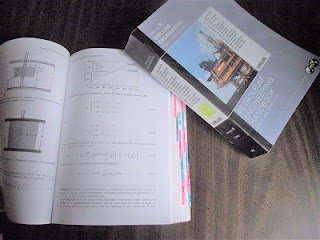
1) Tab each chapter in each volume, clearly labeled (see picture below).
2) Tape a chapter TOC (with page numbers) to both the cover and spine for quick reference.
3) Use pencil to mark passages. Forgo pens or highlighters. As you learn more and gain more experience a lot of the original marks will be obvious and make it hard to discern what's important. You really need to be able to erase and remark as you go.
I try to include relevant quotes from the PEH in the Guidebook. This process is ongoing.
Note the PEH is very long and detailed, so a good percentage of it is simply beyond the scope of the PE exam and most engineering work. Reading it cover-to-cover is not a wise investment of precious time for the typical engineer. So be selective when reading it. Make no mistake, it's a deep dive.
On this blog I'll include an ongoing outline of what I think are "relevant" PEH chapters (starting this week). These posts will be an excellent review for people taking the PE Exam. Everything I include I think is worth knowing and being prepared for.
First: seven volumes?! Clunky.
Second: each chapter is written by a different author so the quality is uneven. It lacks the unity of its single-volume predecessor by Bradley (see my Amazon review linked in the upper-right corner of this blog).
Regardless of one's opinion of the PEH, every PE should purchase and become familiar with it. Bradley is simply too dated, and there is some pretty good stuff in the PEH. After you get used to it, it's really not that bad. However, I do have suggestions to make it more manageable:
1) Tab each chapter in each volume, clearly labeled (see picture below).
2) Tape a chapter TOC (with page numbers) to both the cover and spine for quick reference.
3) Use pencil to mark passages. Forgo pens or highlighters. As you learn more and gain more experience a lot of the original marks will be obvious and make it hard to discern what's important. You really need to be able to erase and remark as you go.
I try to include relevant quotes from the PEH in the Guidebook. This process is ongoing.
Note the PEH is very long and detailed, so a good percentage of it is simply beyond the scope of the PE exam and most engineering work. Reading it cover-to-cover is not a wise investment of precious time for the typical engineer. So be selective when reading it. Make no mistake, it's a deep dive.
On this blog I'll include an ongoing outline of what I think are "relevant" PEH chapters (starting this week). These posts will be an excellent review for people taking the PE Exam. Everything I include I think is worth knowing and being prepared for.

Friday, October 27, 2017
2017 PE Exam Comments
2017 is history. Leave any comments (and suggestions for blog or GB
improvements) in the comments below. I would enjoy hearing from anyone
and everyone.
Please remember the blog rule: prior PE Exam questions, in whole or in part, will NOT be discussed on this blog. General topics, such as resources, testing techniques, or general problems only!
Please remember the blog rule: prior PE Exam questions, in whole or in part, will NOT be discussed on this blog. General topics, such as resources, testing techniques, or general problems only!
Thursday, October 5, 2017
Test Taking Strategy - 2017
Note: I will not talk about specific problems from the exam.
Note: this is a re-post from 2016 with updates for 2017.
First: review the Petroleum Engineering Guidebook in detail and SPE Textbook Series #1, #2, #12, and #4 as time allows. Tab (by letter) a good Petroleum Dictionary. Have the Halliburton Red Book (or equivalent) and Well Control or something similar (for the pictures). Consider investing in the 7 volume Petroleum Engineering Handbook; you really should own it anyway and it helps a lot of folk on the exam. Regardless, know whatever resources you choose very well; never waste time searching through books on a hope during a timed exam.
Second: Take the Petroleum PE Problems 2016: 1-40 or the 2005 SPE Sample Exam 1-40. It's critical to take it under actual test conditions. Lock yourself in a room for four hours with your books, calculator, mechanical pencil, and whatever you will eat and drink. If you lack four uninterrupted hours, do 10 problems in 1 hour for the same effect.
Third: Take, practice, and completely understand every problem on the 2005 SPE Sample Exam 1-80. This is your calculation problem study time. Do every problem as many times as needed until each one takes less than 6 minutes each (on average).
Fourth: Review whatever reservoir textbook you are familiar with. If you have time, you might want to do and completely understand every problem on the 2014 SPE Practice Exam (this isn't like the actual exam, it's mostly easy and fast, but worth a look if you have extra time). Study any weak areas.
Fifth: Take the 2016 Petroleum PE Problems 2016: 41-80. If you don't have it, use the 2005 Practice Exam 41-80. This is your final check. If you can get 70% under exam conditions, you will probably pass the real thing. If you can get 60%, it's worth a shot. Use this test to hone your resources and test-taking skills under time constraints.
Sixth: Sometime in the month before the exam, take the Petroleum PE Problems 2017: 1-80. Take it as if it's real, including resources, food, and restroom breaks. Regroup and study as needed. If you have the opportunity to take review courses (Bing is highly recommended) do so. The lectures are invaluable, especially for engineers without a petroleum degree.
Regarding studying: I didn't find practicing calculation problems to help much past a certain point. If you can do every problem on the 2005 exam within time constraints (average 6 minutes per problem), you should be good to go on calculations.
Regarding the futility of studying calculation problems to prepare for the PE Exam? Read David Vaucher who after taking the 2014 exam said, "I think I did well. I’m confident because I spent ample time preparing..." and "...I am certain that I got all the calculation questions right...". But to his chagrin he then learned he did not pass. Think about that. He believes he didn't miss a single calculation problem...yet did not pass! This demonstrates the danger of relying on calculation problems.
So how should one prepare? Focus on high-quality (but limited) resources, achieve real understanding, and hone your test-taking skills. This was how I generated my study notes (now Guidebook) during the years I waited to take the exam. My notes summarized the main points from SPE textbooks. And little else. If there was something on the exam not in my notes (rare!) I merely skipped it, confident that the question was esoteric and thus a time sink to be avoided. A willingness to "let it go" is far more important than the natural (and normally healthy) urge to chase down the correct answer on every problem and thus run out of time.
You have probably heard the joke that to avoid being eaten by a charging bear you don't have to outrun the bear, just the other guy? Well you don't need to get every answer right on this exam. You just need more answers correct than about half the other guys.
Note: this is a re-post from 2016 with updates for 2017.
First: review the Petroleum Engineering Guidebook in detail and SPE Textbook Series #1, #2, #12, and #4 as time allows. Tab (by letter) a good Petroleum Dictionary. Have the Halliburton Red Book (or equivalent) and Well Control or something similar (for the pictures). Consider investing in the 7 volume Petroleum Engineering Handbook; you really should own it anyway and it helps a lot of folk on the exam. Regardless, know whatever resources you choose very well; never waste time searching through books on a hope during a timed exam.
Second: Take the Petroleum PE Problems 2016: 1-40 or the 2005 SPE Sample Exam 1-40. It's critical to take it under actual test conditions. Lock yourself in a room for four hours with your books, calculator, mechanical pencil, and whatever you will eat and drink. If you lack four uninterrupted hours, do 10 problems in 1 hour for the same effect.
Third: Take, practice, and completely understand every problem on the 2005 SPE Sample Exam 1-80. This is your calculation problem study time. Do every problem as many times as needed until each one takes less than 6 minutes each (on average).
Fourth: Review whatever reservoir textbook you are familiar with. If you have time, you might want to do and completely understand every problem on the 2014 SPE Practice Exam (this isn't like the actual exam, it's mostly easy and fast, but worth a look if you have extra time). Study any weak areas.
Fifth: Take the 2016 Petroleum PE Problems 2016: 41-80. If you don't have it, use the 2005 Practice Exam 41-80. This is your final check. If you can get 70% under exam conditions, you will probably pass the real thing. If you can get 60%, it's worth a shot. Use this test to hone your resources and test-taking skills under time constraints.
Sixth: Sometime in the month before the exam, take the Petroleum PE Problems 2017: 1-80. Take it as if it's real, including resources, food, and restroom breaks. Regroup and study as needed. If you have the opportunity to take review courses (Bing is highly recommended) do so. The lectures are invaluable, especially for engineers without a petroleum degree.
Regarding studying: I didn't find practicing calculation problems to help much past a certain point. If you can do every problem on the 2005 exam within time constraints (average 6 minutes per problem), you should be good to go on calculations.
Regarding the futility of studying calculation problems to prepare for the PE Exam? Read David Vaucher who after taking the 2014 exam said, "I think I did well. I’m confident because I spent ample time preparing..." and "...I am certain that I got all the calculation questions right...". But to his chagrin he then learned he did not pass. Think about that. He believes he didn't miss a single calculation problem...yet did not pass! This demonstrates the danger of relying on calculation problems.
So how should one prepare? Focus on high-quality (but limited) resources, achieve real understanding, and hone your test-taking skills. This was how I generated my study notes (now Guidebook) during the years I waited to take the exam. My notes summarized the main points from SPE textbooks. And little else. If there was something on the exam not in my notes (rare!) I merely skipped it, confident that the question was esoteric and thus a time sink to be avoided. A willingness to "let it go" is far more important than the natural (and normally healthy) urge to chase down the correct answer on every problem and thus run out of time.
You have probably heard the joke that to avoid being eaten by a charging bear you don't have to outrun the bear, just the other guy? Well you don't need to get every answer right on this exam. You just need more answers correct than about half the other guys.
Wednesday, September 20, 2017
2017 Test Study Plan
If you passed the 2016 Exam, congratulations. I'm hearing from a lot of you who did [edit: rumor has it the cut-off score is 43; if you agree or know different, please leave a comment below].
If you didn't pass, don't let it get to you. It's no big deal. What doesn't kill you only makes you stronger. Remember, anyone who can pass the FE exam has already shown they have the brains to pass the PE if they 1) study enough, 2) keep a positive mental attitude, and 3) do enough practice exams or similar problems.
My study suggestions for 2017:
1) Read the 2016 exam comment thread (link to left) and every blog post regarding testing methods and resources.
2) Select and acquire your chosen resources. Start reading them today.
3) Read the Guidebook carefully, every word, until you know it extremely well. Learn any concept in it you don't completely understand. Tab chapters; practice using the TOC. Ensure you have the second printing (I'll update your old one for free).
4) Get to where you can solve every 2004 Sample Exam question in under 6 minutes. The 2004 is not like the modern PE exam but it's a great tool for subject mastery. If you have questions about any particular problem, I have similar example problems linked on the right-side of this blog.
5) Months before your 2017 test date (I prefer 6 months) take the 2016 AM Practice Exam (under test conditions). From this experience, decide on your "testing strategy". My preference is 5 problems (done in order) each half-hour, never to return. However, many people prefer to do the easy ones first, or even do them by subject. Choose your method now, in order to practice it on future practice exams. You will test like you practice.
6) Study weak areas. Continue to do practice exams or realistic problems. Make sure that you fully understand every problem you see on a practice exam, even if you get it correct. On the real exam, you will be under stress and may not be so lucky.
If you don't intend to use the Guidebook or Practice Exams, that's no problem, just make sure you know your primary resources well. If you can afford it, take Bing's class (see link to the lower left). You can also learn problems from any SPE Textbook Series as practice problems, or the SPE Certification Exam. There are lots of free options out there.
I don't recommend bringing sample exam problems to the real exam. You won't have the time to be looking around for similar problems when testing. To highlight a particular problem, make notes in your primary resource.
Monday, September 18, 2017
Q & A
I often get questions about what is the best "method" to take the PE exam.
Here's my experience. Keep in mind everyone is different and YMMV.
1) I brought all my books (3 totes on small dolly) and faced them up (like a laying-down bookshelf) in an organized way (how I did my practice tests). Those totes sat on the floor to my left and right. I had the entire 7 HS, 12 TS, a dozen spiral-bound API docs, Redbook, Dictionary, Well Control, Bradley, Bing, Mian, etc.,etc. This setup was an absolute waste of time. But it made me feel better!
2) I kept the GB, calculator, pencil, paper, test book on my desk. The desk was big and roomy. The wall clock was fine, but we didn't start on time on either half-test, which threw me off on how I watched my timing.
3) Wore one digital watch with no sound (a guy got kicked out of our test for his watch beeping a single beep just twice!).
4) Wife brought a light lunch; I ate in the testing building. I brought no food into the exam itself and drank a limited amount of water (to avoid the restroom). My intent was to take NoDoz or Jet Alert for a caffeine buzz, but forgot them. And I was tired too: I packed late plus goofed off the night before. Yep, I was that stupid...
5) Earplugs were provided (use them!), pencil, paper. I never used my straight edge. No time.
What worked best for me regarding test strategy?
A) I divided each half-exam's 40 problems into 8 "mini tests"; 5 problems each 30 minutes. I did them in order. With leftover time, I checked and rechecked those five problems until my 30 minutes was up. If I couldn't finish one or more within the 30 minutes, I moved on, never to return.* I believe this was the most important thing I did when taking the exam because if forced me into rigorous time management.
B) I resisted opening any book (besides the GB, dictionary, or Redbook) until I was done and checking my work. This prevented me from "flipping pages" in vain on any particular problem. I think this was the second most important thing I did.
C) The dictionary was the unexpected killer resource (thanks Bing!). I used it at least 3 times to help get to an answer. I had mine tabbed by letter. It's a must have. Tab it and get used to using it on practice exams.
D) I used the HS, TS, and Well Control (for the pictures) several times to check answers. They never helped me actually get answers, just confirm what I already suspected, or had in my notes (GB). But I did waste at least 15-20 minutes looking around in them.
E) *I ignored 2 esoteric or long questions (each half exam) until the end (this saved 15 minutes which I used to revisit them at the end of the exam). If I wasn't familiar with a problem, I just worked it fast and moved on, expecting to miss it. But that was rare. I found the test subject matter fair and as expected. I didn't have a desire to add anything to my notes (GB) at the end of the exam.
F) Each hour, I forced myself to stop, put my pencil down. close my eyes, and breath deeply for 15 whole seconds. Best move ever. It's hard to give up that minute, but it made me more productive.
G) I always reviewed/checked my work on all five problems at the end of each 30 minute mini-test. I felt good doing most problems, yet caught at least 3 mistakes each half-exam! Tricks. And these were problems I was confident I knew how to do; I was merely doing a routine check. This left me jittery and unsure of myself. How many more did I miss? So I left the exam wondering if I had passed, but reflecting I realized I probably did very well because of my paranoia.
What surprised me?
I) My many books didn't help me at all (like many others think they do). If anything, they hurt me by using valuable time (except the dictionary; that was an awesome tool; HT Bing!).
2) How much my notes (now the GB) helped to "center" me and remind me what I already knew. At the start of any problem, I always flipped to the relevant GB chapter for a quick scan for a refresher. I can't explain how hard it was to switch from drilling to rod pumps to reservoir to API specs to some word problem about geology to...you get the idea. I simply can't adjust like that effectively without a quick overview of the subject to focus my mind.
3) How difficult it was to manage time, stay focused, and remain unemotional for 8 hours. It was the hardest and longest exam I've ever taken. It's not a sprint; it's a marathon and the winners separate themselves from the pack in the second half, long after the excitement is gone. It's all about pace, stamina, and time management.
4) How much the lectures from Bing's class helped. Especially the review of TS1 and TS2. I missed taking the exam in 2014, the year I took Bing's class, yet I still remembered quite a bit from the lectures. Lots of good stuff in those lectures if you are lucky enough to be able to take it. See the link to the lower left to find out more about Bing and when his classes are available.
Here's my experience. Keep in mind everyone is different and YMMV.
1) I brought all my books (3 totes on small dolly) and faced them up (like a laying-down bookshelf) in an organized way (how I did my practice tests). Those totes sat on the floor to my left and right. I had the entire 7 HS, 12 TS, a dozen spiral-bound API docs, Redbook, Dictionary, Well Control, Bradley, Bing, Mian, etc.,etc. This setup was an absolute waste of time. But it made me feel better!
2) I kept the GB, calculator, pencil, paper, test book on my desk. The desk was big and roomy. The wall clock was fine, but we didn't start on time on either half-test, which threw me off on how I watched my timing.
3) Wore one digital watch with no sound (a guy got kicked out of our test for his watch beeping a single beep just twice!).
4) Wife brought a light lunch; I ate in the testing building. I brought no food into the exam itself and drank a limited amount of water (to avoid the restroom). My intent was to take NoDoz or Jet Alert for a caffeine buzz, but forgot them. And I was tired too: I packed late plus goofed off the night before. Yep, I was that stupid...
5) Earplugs were provided (use them!), pencil, paper. I never used my straight edge. No time.
What worked best for me regarding test strategy?
A) I divided each half-exam's 40 problems into 8 "mini tests"; 5 problems each 30 minutes. I did them in order. With leftover time, I checked and rechecked those five problems until my 30 minutes was up. If I couldn't finish one or more within the 30 minutes, I moved on, never to return.* I believe this was the most important thing I did when taking the exam because if forced me into rigorous time management.
B) I resisted opening any book (besides the GB, dictionary, or Redbook) until I was done and checking my work. This prevented me from "flipping pages" in vain on any particular problem. I think this was the second most important thing I did.
C) The dictionary was the unexpected killer resource (thanks Bing!). I used it at least 3 times to help get to an answer. I had mine tabbed by letter. It's a must have. Tab it and get used to using it on practice exams.
D) I used the HS, TS, and Well Control (for the pictures) several times to check answers. They never helped me actually get answers, just confirm what I already suspected, or had in my notes (GB). But I did waste at least 15-20 minutes looking around in them.
E) *I ignored 2 esoteric or long questions (each half exam) until the end (this saved 15 minutes which I used to revisit them at the end of the exam). If I wasn't familiar with a problem, I just worked it fast and moved on, expecting to miss it. But that was rare. I found the test subject matter fair and as expected. I didn't have a desire to add anything to my notes (GB) at the end of the exam.
F) Each hour, I forced myself to stop, put my pencil down. close my eyes, and breath deeply for 15 whole seconds. Best move ever. It's hard to give up that minute, but it made me more productive.
G) I always reviewed/checked my work on all five problems at the end of each 30 minute mini-test. I felt good doing most problems, yet caught at least 3 mistakes each half-exam! Tricks. And these were problems I was confident I knew how to do; I was merely doing a routine check. This left me jittery and unsure of myself. How many more did I miss? So I left the exam wondering if I had passed, but reflecting I realized I probably did very well because of my paranoia.
What surprised me?
I) My many books didn't help me at all (like many others think they do). If anything, they hurt me by using valuable time (except the dictionary; that was an awesome tool; HT Bing!).
2) How much my notes (now the GB) helped to "center" me and remind me what I already knew. At the start of any problem, I always flipped to the relevant GB chapter for a quick scan for a refresher. I can't explain how hard it was to switch from drilling to rod pumps to reservoir to API specs to some word problem about geology to...you get the idea. I simply can't adjust like that effectively without a quick overview of the subject to focus my mind.
3) How difficult it was to manage time, stay focused, and remain unemotional for 8 hours. It was the hardest and longest exam I've ever taken. It's not a sprint; it's a marathon and the winners separate themselves from the pack in the second half, long after the excitement is gone. It's all about pace, stamina, and time management.
4) How much the lectures from Bing's class helped. Especially the review of TS1 and TS2. I missed taking the exam in 2014, the year I took Bing's class, yet I still remembered quite a bit from the lectures. Lots of good stuff in those lectures if you are lucky enough to be able to take it. See the link to the lower left to find out more about Bing and when his classes are available.
Tuesday, March 14, 2017
Question: Ton Mile (TM) Calculations
Q1: In the Guidebook, page 1 RIG 5 says: "RTTM equation assumes DP to bit, so wdp is subtracted from wbha." What are the mechanics behind this? Is there anything online to help understand this?
This formula is found many places and formats; I think this version is from Lapeyrouse's Formulas and Calculations for Drilling, Production, and Workovers. It's a good field book. And while this sort of problem may be too "real world" for a typical PE Exam question, I include it because something like it could easily show up.
The equation used assumes the DP goes all the way to the bit, then subtracts the DP over the BHA length later. There are other ways to skin this cat but I prefer this method because I find it faster. And speed is everything on the exam.
Q2: On 1 RIG 5, why is tripping RTTM multiplied by 1, coring by 2, & drilling by 3?
For drilling or "connection" TM, use the TM for actual drilling, plus the TM for picking up, connecting, and starting to drill again. This is 3 lengths, so multiply by 3 over the drilling depth.
For coring, you don't need to pick up again; just add another stick. So you multiply by 2.
This would be a great word problem for the PE Exam, to test one's understanding of how the TM equation actually works. So it's an excellent question. It's very easy for a test writer to nail those who survive by "plug-and-chug" and lack understanding.
Tuesday, February 28, 2017
Question: Units
I recently received an interesting question:
While reading through the Fundamentals of Drilling Engineering book (great recommendation, by the way---SO much better than the older version!) I noticed the book recommends converting everything to SI, and then when solving go back to field units. I think your guidebook has most equations with constants to automatically solve in field units, right? What is your recommendation as far as going back and forth? As a ChemE used to doing tons of unit conversions, sometimes I am blown away by the constants that magically turn the answer into the right units. Interested to know your thoughts.
First, this reader is correct on the quality of the FDE book. It's clearly a big-time reference used for the PE Exam. If I could study only one book, it would be this one. It's a bit large to use for an exam reference (the Guidebook though has most of what you need from the FDE) but it's excellent to study from. Every engineer should read through it and know what's in it well.
To answer the question: this exam is a speed demon. Excess unit conversions should be ignored in nearly all situations except reservoir, where it makes sense to quickly convert units to whatever is familiar to you.
Sidenote: It's extremely hard (especially for good engineers) to "let go" of the precision and detail that's natural to them at work. Well, this PE Exam is not a "normal" situation. You are going to miss problems that would get you fired in real life due to the rush. Accept it. Get used to it. In fact, a large part of one's study plan should be practicing this "letting go", that is, of getting used to guessing on difficult problems long before they become a time sink. And most importantly, not letting this effect your positive mindset for the rest of the exam. Use timed, realistic practice exams to drive home this mental switch.
While reading through the Fundamentals of Drilling Engineering book (great recommendation, by the way---SO much better than the older version!) I noticed the book recommends converting everything to SI, and then when solving go back to field units. I think your guidebook has most equations with constants to automatically solve in field units, right? What is your recommendation as far as going back and forth? As a ChemE used to doing tons of unit conversions, sometimes I am blown away by the constants that magically turn the answer into the right units. Interested to know your thoughts.
First, this reader is correct on the quality of the FDE book. It's clearly a big-time reference used for the PE Exam. If I could study only one book, it would be this one. It's a bit large to use for an exam reference (the Guidebook though has most of what you need from the FDE) but it's excellent to study from. Every engineer should read through it and know what's in it well.
To answer the question: this exam is a speed demon. Excess unit conversions should be ignored in nearly all situations except reservoir, where it makes sense to quickly convert units to whatever is familiar to you.
Sidenote: It's extremely hard (especially for good engineers) to "let go" of the precision and detail that's natural to them at work. Well, this PE Exam is not a "normal" situation. You are going to miss problems that would get you fired in real life due to the rush. Accept it. Get used to it. In fact, a large part of one's study plan should be practicing this "letting go", that is, of getting used to guessing on difficult problems long before they become a time sink. And most importantly, not letting this effect your positive mindset for the rest of the exam. Use timed, realistic practice exams to drive home this mental switch.
Tuesday, November 1, 2016
Friday, October 28, 2016
Open Thread - 2016 PE Exam Comments
2016 is history. Leave any comments (and suggestions for blog and GB improvements) in the comments below. I would enjoy hearing from anyone and everyone.
Thursday, August 11, 2016
Questions: Practice Exam
Question: Is the Practice Exam available in hardcopy, or just Kindle?
Answer: Kindle only. It's easy to use; just download the free app to your phone or computer. Then scratch paper is all you need.
Question: On your practice exam, did you come up with the problems yourself or are you getting them from other practice exams, or Bing's class?
Answer: My practice exam problems are from my Guidebook. Bluntly, I just made them up. There is nothing copied from anyone else. Sources for the Guidebook (and thus my practice exam) are listed in the Guidebook on each page. At the end of the exam, it shows the exact page of the Guidebook used to create the problem.
My problems are not much like Bing's (mine are mostly word problems, for example). Bing's problems are broken up into parts for studying and learning, while mine are in an exam format.
Sidenote: Bing's class is AWESOME. I took it several times. I think every petroleum engineer should take it, exam or no. However, my Guidebook and practice exams are a very different approach. I do think they work well together though; everyone has a different learning style.
Answer: Kindle only. It's easy to use; just download the free app to your phone or computer. Then scratch paper is all you need.
Question: On your practice exam, did you come up with the problems yourself or are you getting them from other practice exams, or Bing's class?
Answer: My practice exam problems are from my Guidebook. Bluntly, I just made them up. There is nothing copied from anyone else. Sources for the Guidebook (and thus my practice exam) are listed in the Guidebook on each page. At the end of the exam, it shows the exact page of the Guidebook used to create the problem.
My problems are not much like Bing's (mine are mostly word problems, for example). Bing's problems are broken up into parts for studying and learning, while mine are in an exam format.
Sidenote: Bing's class is AWESOME. I took it several times. I think every petroleum engineer should take it, exam or no. However, my Guidebook and practice exams are a very different approach. I do think they work well together though; everyone has a different learning style.
Monday, July 4, 2016
Questions: 2009 & 2011 Exams
I received a good question today: In addition to your 2016 Sample Problems and the 2004 Sample Exam. what do you think of the 2009 AND 2011 SPE/PE study guide questions?
My response: You have limited time, so make the most of it. And that is the 2016 & 2017 Practice Exams, the 2004 Sample Exam, the 2014 Practice Exam, and of course the Guidebook. First know those like the back of your hand.
Only after all that would I study the 2009 & 2011 Exams.
Friday, May 20, 2016
Questions: Certification Exam
I'm currently talking with several people who are taking the 2016 PE Exam, and the same questions keep coming up:
1) What is the test like? Is it theory or problems?
2) Is Bing Wines class helpful?
3) Is the Certification Exam worth taking?
4) What is a good study plan?
The first two questions are answered here.
Regarding the Certification Exam: I've never taken it, and don't know much about it.
However: resource selection and use is key to doing well on the PE Exam. And the Certification Exam doesn't allow you to use your own resources. Therefore, I question it's value for the PE Exam. I would probably focus on one of the exams at a time.
For a good "at home" PE Exam study plan:
a) Read this.
b) Read the entire Guidebook, know it well, and study any weak areas. If you don't want to use it, know SPE Textbook Series #1, #2, #4, #12, and #8 (or your own reservoir book) at a minimum.
c) Take the 2016 Petroleum PE Practice Exam Morning Section (under test conditions, or 10 problems in an hour) to get a taste of the exam's pace. If you don't want to use this practice exam, the 2004 Morning Section will work (link at lower left).
d) Know every problem on the 2004 Sample Exam.
e) Take the 2016 Petroleum PE Practice Exam Afternoon Section (under test conditions, or 10 problems in an hour). If you don't want to use this exam, the 2004 Afternoon Section will work.
If you can get 70% you will likely pass the real thing. Even if you can get 60%, take it anyway, since your odds are fair.
If you have questions, leave me one in the comment box and I'll try to answer it. Good luck!
1) What is the test like? Is it theory or problems?
2) Is Bing Wines class helpful?
3) Is the Certification Exam worth taking?
4) What is a good study plan?
The first two questions are answered here.
Regarding the Certification Exam: I've never taken it, and don't know much about it.
However: resource selection and use is key to doing well on the PE Exam. And the Certification Exam doesn't allow you to use your own resources. Therefore, I question it's value for the PE Exam. I would probably focus on one of the exams at a time.
For a good "at home" PE Exam study plan:
a) Read this.
b) Read the entire Guidebook, know it well, and study any weak areas. If you don't want to use it, know SPE Textbook Series #1, #2, #4, #12, and #8 (or your own reservoir book) at a minimum.
c) Take the 2016 Petroleum PE Practice Exam Morning Section (under test conditions, or 10 problems in an hour) to get a taste of the exam's pace. If you don't want to use this practice exam, the 2004 Morning Section will work (link at lower left).
d) Know every problem on the 2004 Sample Exam.
e) Take the 2016 Petroleum PE Practice Exam Afternoon Section (under test conditions, or 10 problems in an hour). If you don't want to use this exam, the 2004 Afternoon Section will work.
If you can get 70% you will likely pass the real thing. Even if you can get 60%, take it anyway, since your odds are fair.
If you have questions, leave me one in the comment box and I'll try to answer it. Good luck!
Subscribe to:
Posts (Atom)